10th August, 2020
John has been involved in the following pieces of work:
A chapter entitled ‘Poetry: telling it like it is’ in The Practical Handbook of Dementia edited by Roz Austin and Mark Hopfenbeck is to be published by PCCS Books in 2021.
A paper describing the Bangor University project in which John had a key role (and Kate an ancillary one) is now available to download. It is entitled Enhancing Communication between Dementia Care Staff and their Residents in Arts-inspired Interaction. It has been published in ‘Aging and Mental Health’ Volume 24 Issue 8. It can be accessed here
John has been involved in the following pieces of work:
A chapter entitled ‘Poetry: telling it like it is’ in The Practical Handbook of Dementia edited by Roz Austin and Mark Hopfenbeck is to be published by PCCS Books in 2021.
A paper describing the Bangor University project in which John had a key role (and Kate an ancillary one) is now available to download. It is entitled Enhancing Communication between Dementia Care Staff and their Residents in Arts-inspired Interaction. It has been published in ‘Aging and Mental Health’ Volume 24 Issue 8. It can be accessed here
|
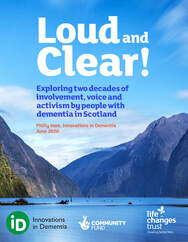
John has made a contribution to a book entitled Loud and Clear edited by Philly Hare of ‘Innovations in Dementia’ and published by Life Changes Trust in Scotland. It tells the story of how people living with the condition north of the border have become activists and influencers in their own right over the past 20 years. At present the book can only be accessed online here |
|

|
Sheffield Hallam University is developing a resource for people with dementia exploring creative opportunities during lockdown and John has contributed units on Reading Poetry and Writing Poetry, and will be adding one on Improvised Drama. Helen Fisher and Claire Craig are masterminding this. To access it click here |
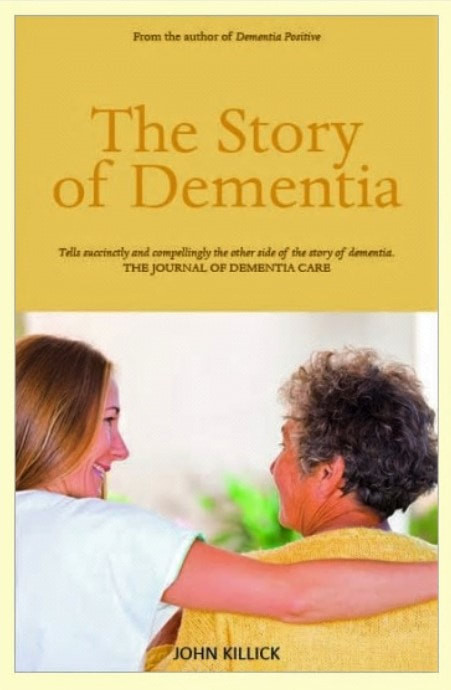
Poetry and Dementia:
|
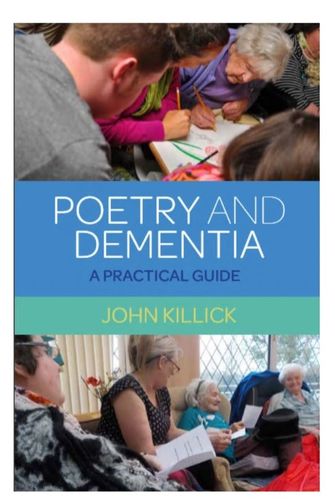
The Story of Dementia by John Killick published August 2017 by Luath Press Quoted from publisher's website: So far as we are aware, there has never been a book before with this title or aim. This may be because no-one has been foolhardy enough to attempt one! And it is true that this is a story in mid-flow, even perhaps still near the beginning. But the subject is so complex, and surrounded with so many misconceptions that, even in a truncated form, it needs to be told. John Killick has chosen a simple but effective format. Each of the nine main chapters focuses on an individual or individuals (twelve in number) who, in his view, have made significant contributions to our knowledge. The message is one of hope. Although the medical model has yielded little in the way of advances, that is not true of psychosocial initiatives. This little book tells the hidden story of positive approaches, and those who have devoted their lives to finding alternative creative solutions to one of today’s great challenges. If your life is at all touched by dementia, you should be reading it. Dementia Positive
Click on the quotations to read the full reviews: ...it was beautifully written with such empathy and understanding... ... his overall thesis of turning the dementia negatives into positives sounds and feels like the ‘right’ approach, something we should embrace and try to implement as best we can. This is a truly beautiful and inspiring book... ...Killick presents a powerful and transformative view of dementia |

|
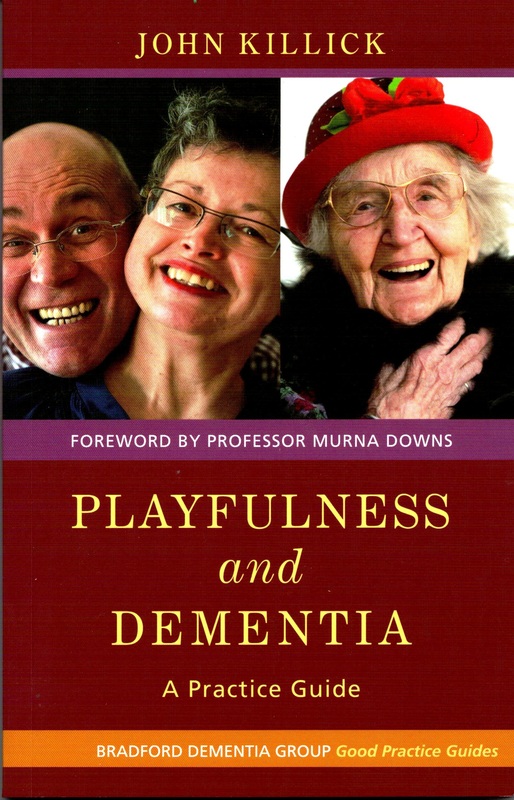
Playfulness and Dementia
John Killick (2013, Jessica Kingsley) "This book is full of ways to connect people through fun. There is nothing disrespectful or silly about the words in this book. It is full of compassion and honesty. It will supply you with a springboard to joy." Professor Dawn Brooker, Director of the Association for Dementia Studies, University of Worcester. "Killick's challenge to us in Playfulness and Dementia is simple and powerful - what is wrong with having a good time when you're living with dementia? His many-faceted story is thoroughly convincing - that play, playfulness and laughter are integral to creativity in dementia, to people's well-being and ultimately to their human right to experience joy." John Zeisel, PhD, founder of the I'm Still Here Foundation and author of I'm Still Here: A New Philosophy of Alzheimer's Care |
|
|
To see a video of a 'funshop' run by John using playfulness activities check out: |
|
New publication: Singing Under Our Breath
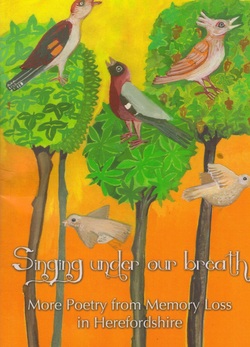
This is the new book from the Courtyard Centre for the Arts project in Hereford, poems drawn from people with memory loss. It is the follow-up to In the Pink, which came out last year. On this occasion John mentored the poets, Deborah Alma, Jacqui Rowe and David Calcutt but did not contribute poems himself. They worked in care homes, day centres and hospital wards in the county. Copies of the book can be obtained from the Courtyard for £3 - boxoffice@courtyard.org.uk or 01432 340555
Here is part of the poem which gave the book its title:
Do you think your voice gets any older?
I'm not sure it does
Perhaps a little
I was a singer
I don't know how good the voice is now
I sing under my breath now
Here is part of the poem which gave the book its title:
Do you think your voice gets any older?
I'm not sure it does
Perhaps a little
I was a singer
I don't know how good the voice is now
I sing under my breath now

The ‘Australian Journal of Dementia Care’, a sister publication
to our UK Journal of Dementia Care, has been launched this month.
It is owned by Hawker Publications and edited by a friend of ours, Professor Richard Fleming of Wollongong University.
John has been engaged as a regular columnist for the AJDC,
and will write about communication and relationships. His
first article ‘Removing the Walls of Fear’ appears in the first issue.